
RECORDS MANAGEMENT OPERATIONS
To be successful, a records management program should be more than just a way to store an organization’s information. At Access Sciences, we specialize in helping organizations streamline records management and efficiently handle public records requests, ensuring compliance, transparency, and operational excellence.
With our proven expertise, we also assist large energy, oil & gas, semiconductor, and petrochemical firms in managing the complexities of records retention, especially when overseeing multiple general contractors during capital construction and equipment projects.
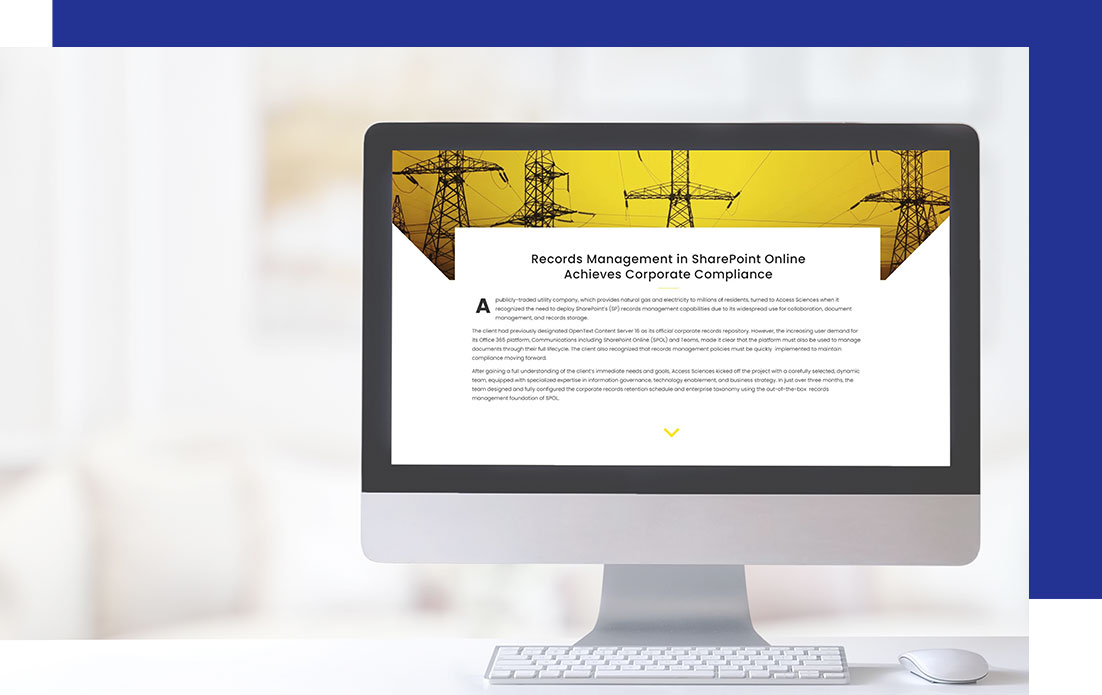
RECORDS MANAGEMENT IN
SHAREPOINT
ONLINE ACHIEVES CORPORATE COMPLIANCE
The client had previously designated OpenText Content Server 16 as its official corporate records repository. However, the increasing user demand for its Office 365 platform, Communications including SharePoint Online (SPOL) and Teams, made it clear that the platform must also be used to manage documents through their full lifecycle.
Program Assessment and Roadmap
We assess current practices and develop program roadmaps to provide structure and address gaps.
Program Design and Implementation
Our experts design and implement sustainable information management and governance programs.
Policy and Process Development
We develop relevant, actionable information management and governance policies and processes.
Record Center Operations
From beginning to end, we do it all – records ingestion, classification, request fulfillment, lifecycle management, and security.
Modus™ Records Retention Schedules
We help organizations to communicate and justify the business need for records and information management programs.
Business Case Development
Our experts design taxonomies so information can be found when needed, regardless of who created it and where it is stored.
Box Inventory Analysis
Our experts help organizations realize cost savings by physically and digitally analyzing boxed records inventories in support of defensible disposition.
Ingestion/Imaging/Classification
Our professionals ingest, image, and classify content, freeing organizations to focus on their core business.
Information Lifecycle Management
We start by understanding not only what records must be kept, but why they should be kept. This helps us determine how long they must be retained, how they should be stored, and when they should be destroyed.

You Asked:
What is the difference between records management and information management?
Records management is focused on what you must do to protect and manage records throughout their lifecycle. It is based on legal and regulatory requirements and has rigorous standards for compliance.
Information management builds on records management and other document management activities to create a comprehensive system of policies, processes, and tools designed to control and maintain information, so that its value can be leveraged throughout its useful life.
Success Story:
Retention Schedule Makeover
This client’s retention schedule had not been updated in 10 years. Its use was limited to physical records and it was not fit for purpose with electronic records or their new content management system. Faced with far too many entries…
Success Story:
1,438% ROI Realized With New Technical Records Program
Records management programs tend to focus on the legal consequences of not keeping records that should be retained, or retaining records that should be destroyed…
Success Story:
Electronic Records and Information Management Program
A state agency with a well-established records management program and a robust physical records management solution in place determined that…